
Table of Contents
If you have heart failure, exercise might feel intimidating – but it’s actually a key part of managing your condition. Research shows regular, moderate activity can strengthen your heart, reduce symptoms like fatigue, and lower hospital readmissions by 11%. Here’s what you need to know:
- Get Medical Clearance First: Your cardiologist will evaluate your heart’s condition and recommend safe activity levels.
- Start Small: Begin with low-impact exercises like walking, stationary cycling, or light resistance training. Aim for 150 minutes of moderate activity per week but start with just 5–10 minutes a day.
- Follow the FITT Principles: Gradually increase Frequency, Intensity, Time, and Type of exercise for safe progress.
- Listen to Your Body: Stop immediately if you experience dizziness, chest pain, or a rapid heart rate that doesn’t settle after rest.
Exercise is safe – even with reduced heart function – when done correctly. Always warm up, cool down, and consult your doctor for a personalized plan.
Guide to Exercising with Congestive Heart Failure
sbb-itb-876ea0d
Get Medical Clearance Before You Start
Before diving into any exercise program, it’s critical to get the green light from your cardiologist. This step isn’t just about safety – it’s about ensuring you get the most out of your workouts while avoiding unnecessary risks.
Why You Need Your Doctor’s Approval
Your cardiologist will use various tests – like an ECG, stress test, or echocardiography – to evaluate your heart’s stability. These tests help determine your ejection fraction, identify any arrhythmias, and set safe activity levels for you. Essentially, they identify how much exercise your heart can handle without triggering symptoms.
Studies back this up. For example, the HF-ACTION trial, which included 2,331 heart failure patients, found that supervised exercise reduced the risk of all-cause mortality or hospitalization by 11%. Even better, it didn’t lead to an increase in adverse cardiovascular events, making it safe even for those with ejection fractions as low as 25%.
"The group that was more supervised had a decrease in hospitalization and no increase in adverse cardiovascular events or defibrillator shocks" – Dr. Melissa Tracy, Cardiologist and Cardiac Rehabilitation Specialist, Rush
At MyCardiologist, specialists conduct thorough evaluations using tools like stress tests and echocardiography. These assessments help create a personalized exercise plan tailored to your heart’s condition, giving you the confidence to exercise safely.
Questions to Ask Your Cardiologist
Heading into your appointment? Be ready with specific questions. For starters, ask: Am I stable enough to begin exercising now, or should I wait? Depending on your condition, your cardiologist may advise waiting a few months after a cardiac event.
Other key questions include:
- What is my target heart rate range?
- What Borg Rating of Perceived Exertion score should I aim for? (Typically, a score of 3 to 5, indicating moderate effort, is recommended.)
You’ll also want to discuss which activities are safest for you. For example, heavy weightlifting or exercising in extreme temperatures might not be suitable depending on your test results. Ask if a supervised cardiac rehabilitation program would be a good fit for you.
Finally, make sure you know the warning signs that should prompt you to stop exercising immediately. Symptoms like dizziness, chest discomfort, or a rapid heart rate that doesn’t settle within 15 minutes of rest are red flags. Don’t forget to ask how your medications might affect your heart rate or exercise tolerance.
| Evaluation Method | How It Helps with Exercise Planning |
|---|---|
| Electrocardiogram (ECG) | Detects abnormal rhythms or ischemia during rest or activity |
| Exercise Stress Test | Measures how much activity your heart can handle before symptoms appear |
| Ejection Fraction Assessment | Determines your heart failure type (HFrEF or HFpEF) and associated risks |
| Borg Rating Scale | Tracks perceived exertion; aim for a moderate level (3 to 5) |
Getting the right clearance and asking these essential questions sets the stage for a safe, effective, and personalized exercise program.
Recommended Exercises for Heart Failure Patients
Once you’ve received medical approval, the next step is choosing activities that fit your heart’s capacity. The good news? You don’t need fancy equipment or a gym membership. Low-impact, moderate-intensity exercises can strengthen your heart safely while keeping risks low. Experts suggest aiming for 150 minutes of moderate exercise per week. But if that feels overwhelming, start small – just 5 to 10 minutes a day – and gradually build up your endurance. Below are some safe and effective exercise options tailored for heart failure patients.
Walking
Walking is one of the easiest and most effective exercises for heart failure patients. It helps improve circulation, boosts oxygen use, and builds endurance – all without putting too much strain on your joints. Start with 5 to 10 minutes at a pace where you can still hold a conversation (this is called the "talk test"). As your stamina improves, add 1 to 2 minutes daily, aiming for 30 to 45 minutes on most days.
Tips for getting started:
- Wear supportive footwear to protect your feet and ankles.
- Stick to level surfaces and consider walking with a partner or close to home.
- Warm up for 5 minutes at a slower pace and cool down for another 5 minutes to help your heart adjust.
Stationary Cycling
If you’re looking for a low-impact, joint-friendly option, stationary cycling is a great choice. It provides a controlled aerobic workout that strengthens your heart without the unpredictability of outdoor terrain. Begin with 10 to 15 minutes at a low resistance level, gradually increasing the duration as you build endurance. Adjust the bike seat so your knee maintains a slight bend at the pedal’s lowest point. Use the "talk test" or a Borg scale rating of 3 to 5 to monitor your intensity.
Swimming and Water Aerobics
Water-based activities are fantastic for heart failure patients. The water provides natural resistance, helping to condition muscles while easing stress on your joints. Swimming, in particular, engages your entire body and improves cardiovascular fitness.
"Swimming is one of those exercises where you encompass everything in one… You have the resistance of the water that’s conditioning your strength." – Dr. Melissa Tracy, Cardiologist and Cardiac Rehabilitation Specialist, Rush
If swimming isn’t your strong suit, water aerobics or walking in chest-deep water can be effective alternatives. Tools like kickboards or pool buoys can help you manage exertion levels, and you can take breaks as needed. Opt for a pool with moderate water temperature to reduce strain on your heart, and always monitor your breathing.
Light Resistance Training
Strength training can be incredibly helpful for heart failure patients. It not only builds muscle but also improves balance, prevents falls, and reduces the workload on your heart during daily tasks. Focus on light weights and high repetitions rather than heavy lifting. Resistance bands, light hand weights (1 to 3 lbs), or even household items like soup cans are excellent starting points. Target major muscle groups like your arms, shoulders, legs, and core.
A few key pointers:
- Avoid holding your breath; instead, exhale during exertion and inhale as you release to keep your blood pressure steady.
- Start with 10 to 15 repetitions per exercise, allowing for adequate rest between sets.
- Avoid full-body weightlifting exercises until your strength improves.
| Exercise Type | Examples | Primary Benefit |
|---|---|---|
| Low-Impact Aerobic | Brisk walking, stationary cycling | Improves cardiovascular efficiency and endurance |
| Water-Based | Swimming, water aerobics, lap kicking | Builds strength with minimal joint stress |
| Strength Training | Resistance bands, light hand weights | Boosts muscle strength, balance, and daily function |
| Mindful Exercise | Tai Chi, yoga | Combines breathing techniques with core stability |
How to Structure Your Exercise Routine: The FITT Principles
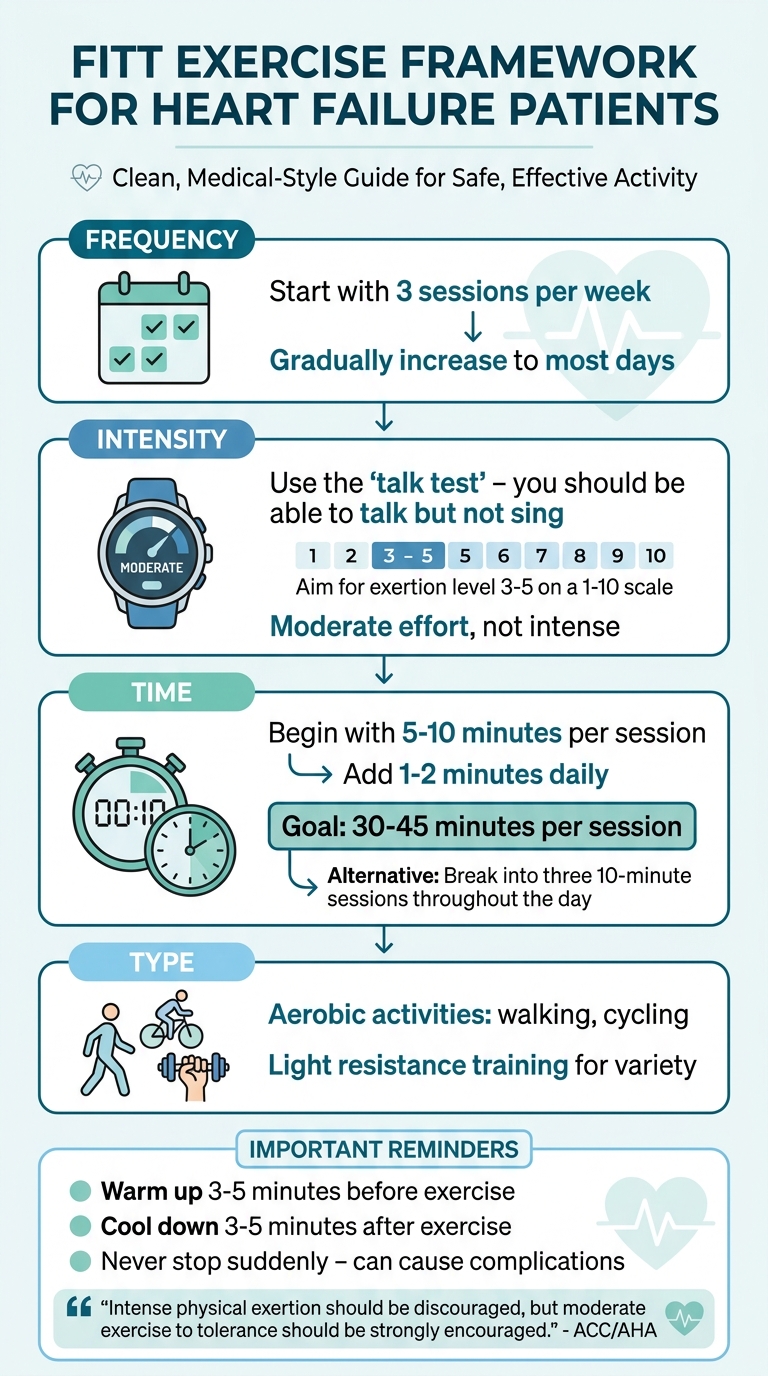
FITT Exercise Framework for Heart Failure Patients
The FITT framework – Frequency, Intensity, Time, and Type – is a helpful guide for building a safe and effective exercise routine. It provides clear guidelines on how often to work out, how hard to push yourself, how long each session should be, and what type of activities to include. For individuals with heart failure, this structure can help improve strength and endurance while staying within safe limits.
Frequency refers to how often you exercise. Start with three sessions per week and gradually work up to exercising most days as you feel stronger. Intensity is about how hard you’re working. A good rule of thumb is the "talk test": aim for a moderate level of effort where you can talk comfortably but not sing. On a scale from 1 to 10, aim for an exertion level of about 3 to 5. Time is the length of each session. Begin with 5 to 10 minutes and add a minute or two each day until you reach 30 to 45 minutes. If that feels overwhelming, break your workout into three 10-minute sessions spread throughout the day. Type focuses on the kind of exercise. Choose aerobic activities like walking or cycling and include light resistance training for variety.
"Intense physical exertion should be discouraged, but moderate exercise to tolerance should be strongly encouraged."
Don’t skip a proper warm-up and cool-down. Spend 3 to 5 minutes at the start and end of each session to stabilize your heart rate and blood pressure. Stopping suddenly can lead to complications, so cooling down is especially important. Following this structure can help you set achievable goals and build a sustainable routine.
Start with Achievable Goals
When you’re just starting out, setting realistic goals is key to staying consistent. Even a 5-minute session can be a great starting point if you’re new to exercise or have been inactive for a while. Gradually increase the duration as your strength improves. Many people with heart failure find that exercising in the morning works best, as it aligns with medication schedules and meal timing.
Wait at least an hour after eating a light meal before starting your workout, and avoid exercising on a full stomach. If you’re incorporating resistance bands or light weights, aim for 10 to 15 repetitions per exercise. Focus on building strength slowly rather than pushing to the point of exhaustion. Research shows that even patients with significantly reduced ejection fractions can exercise safely when following proper guidelines.
Track Your Progress and Make Adjustments
Keeping track of your workouts helps you stick to the FITT framework and make necessary adjustments. Use the "talk test" as your primary guide – if you find it hard to talk during exercise, you may be overexerting yourself. You can also use a perceived exertion scale, such as the Borg scale. Aim for a rating of 2 to 3 during your warm-up and 5 to 7 during the main part of your workout.
Logging your activity – whether in a notebook or a fitness app – can help you monitor your progress. Record details like the duration of each session, the type of exercise, and how you felt afterward. Sharing this information with your healthcare provider during check-ups can provide valuable insights.
Pay close attention to how your body recovers. If your heart rate stays elevated for more than 15 minutes after finishing your workout or if you experience dizziness, chest pain, nausea, or excessive sweating, stop immediately and consult your doctor. These symptoms could indicate that your body needs more time to adapt or that your routine needs adjustments. On the other hand, if you recover quickly and feel good, you may be ready to gradually increase your session duration or add an extra workout day.
Safety Guidelines for Exercise
When following the FITT principles for structuring your exercise routine, it’s essential to pay close attention to how your body responds. If you experience chest pain, discomfort, dizziness, nausea, a rapid or irregular heartbeat, extreme fatigue, weakness, or shortness of breath that makes it hard to speak, stop exercising immediately. These symptoms are red flags, and if they occur while at rest or are paired with swelling or confusion, it’s critical to call 911 or contact your doctor right away. Feeling slightly sweaty or tired during exercise is normal, but you should always be able to carry on a conversation while working out.
Warning Signs to Watch For
Be on the lookout for specific warning signs during exercise. For example, if your heart rate remains elevated and doesn’t return to normal after 15 minutes of rest, it’s time to notify your doctor. Avoid lying down right after working out, as this can interfere with your body’s recovery; instead, keep moving at a very slow pace during your cool-down. If you occasionally feel lightheaded or dizzy, using a walking stick during brisk walks can offer extra stability.
| Perceived Exertion (Borg Scale) | Description | Recommended Action |
|---|---|---|
| 1 | At rest | Baseline |
| 2 – 3 | Light activity | Ideal for warm-ups; heart rate slightly elevated |
| 3 – 5 | Moderate activity | Target zone for most; you should be able to talk but not sing |
| 5 – 7 | Aerobic zone | For conditioned individuals; sweating but still able to converse |
| 8 – 10 | Strenuous/Anaerobic | Unsafe for heart failure patients; stop and rest immediately |
Using Heart Rate Monitors and Wearable Devices
Wearable technology can be a helpful tool for staying within safe exercise limits. Devices like pedometers, heart rate monitors, and fitness trackers provide real-time feedback on your exertion levels. Your cardiologist might also recommend specific heart rate ranges tailored to your individual health needs. During your cool-down, continue light activity until your heart rate drops below 120 beats per minute. Combining these devices with the talk test gives you a reliable way to monitor exercise intensity. Don’t forget to stay hydrated and keep an eye on environmental conditions to further ensure safety.
Hydration and Temperature Control
Proper hydration and temperature management are especially important for individuals with heart failure. Since many patients have water intake restrictions, consult your doctor before starting an exercise routine. Sports drinks are not recommended, as their high sodium content can lead to dangerous fluid retention.
"Drinking a large quantity of sodium will lead to fluid retention" – Elizabeth Hanes, RN
Temperature extremes can also pose risks. Avoid outdoor exercise when temperatures dip below 40°F or climb above 80°F. During hot weather, plan workouts for early morning or after sunset when it’s cooler. In cold conditions, limit outdoor activity to 30 minutes, and remember that heavy winter clothing can add extra strain and lead to excessive sweating. To maintain consistency, consider indoor options like gyms, shopping malls, or climate-controlled spaces.
Conclusion
Starting an exercise program can make a big difference in both your overall quality of life and your heart health. Exercise is considered a Class IA recommendation, meaning it’s highly encouraged for improving heart function. However, it’s crucial to get medical clearance before you begin any new fitness routine to ensure safety and effectiveness.
For those with heart conditions, focusing on low-impact aerobic activities like walking, swimming, or stationary cycling is a good starting point. Research shows that even high-risk patients, such as those with an ejection fraction of 25% or less, can benefit from regular exercise. Dr. Melissa Tracy, a cardiologist at Rush, emphasizes this point:
"The plan with exercise is for improvement. Absolutely. Just like when we prescribe medications, the goal is not to just sustain you, but to get improvement for sure."
Listening to your body is key. Pay close attention to warning signs such as chest pain or dizziness, and stop exercising immediately if they occur. To keep your workout intensity in check, use the talk test – if you can speak comfortably, you’re likely at a safe level. Additionally, warming up and cooling down for 5–10 minutes helps your heart adjust more smoothly to changes in activity. Studies suggest that maintaining a routine of 150 minutes of exercise per week can lead to an 11% reduction in all-cause mortality or hospitalizations for heart failure patients.
These recommendations offer a foundation for a safe and effective exercise routine. For tailored support, the cardiologists at MyCardiologist provide personalized exercise plans based on your unique heart condition, medications, and fitness level. Whether you need clearance to start, ongoing monitoring, or guidance in managing symptoms during activity, expert care ensures you stay on the right path. Trust MyCardiologist to help you exercise safely and confidently – your heart deserves it.
FAQs
How do I know my heart failure is stable enough to exercise?
Before starting any exercise routine with heart failure, it’s crucial to check in with your healthcare provider. Stability usually means you haven’t experienced worsening symptoms like more shortness of breath, swelling, or fatigue, and your doctor has given the green light. Sometimes, they might suggest tests like a stress test to assess your readiness.
Once you’re cleared, begin with gentle activities such as walking or water-based exercises. Gradually increase the intensity, keeping a close eye on how your body responds to avoid overexertion.
What should I do if my heart rate stays high after a workout?
If your heart rate stays high after exercise, it’s a good idea to reach out to your healthcare provider. A prolonged elevated heart rate might indicate an unusual response or a potential health issue, particularly for individuals dealing with heart failure. Making sure your workout routine aligns with your health needs is crucial for your safety.
How can I exercise safely if I have a fluid restriction?
If you’re on a fluid restriction, it’s important to ease into exercise slowly, keep a close eye on your symptoms, and consult your healthcare provider before starting or adjusting your routine. This helps ensure your activities align with your health needs. Listen to your body, and stop immediately if you feel unwell.